Answer Engine Optimization: A 2026 Guide
Unlock your brand's potential with answer engine optimization. Learn how to structure content for AI and boost visibility in 2026.
Answer engine optimization (AEO) is the practice of structuring your brand's digital content so AI-powered systems can extract, cite, and surface it directly in generated answers. Where traditional SEO chases a ranking on a results page, AEO targets the answer itself. Think of it as writing for the machine that writes the answer, not the human who reads the results list.
The AI engines involved are no longer niche tools. ChatGPT has reached 800 million weekly active users, and Google AI Overviews now appear on a significant share of commercial queries. Platforms like Profound and a growing ecosystem of large language models (LLMs) are pulling brand content into synthesized responses every day. If your content is not structured for extraction, it simply does not exist in those answers.
Here is what AEO actually involves:
- Goal shift: AEO optimizes for AI citations and brand mentions, not click-through rates.
- Content unit: The building block is a self-contained chunk, typically an H2 or H3 heading plus its associated text, that answers a query without needing surrounding context.
- Retrieval mechanism: AI systems use retrieval-augmented generation (RAG) to pull these chunks and synthesize answers. Your content needs to be the easiest, most authoritative chunk to quote.
- Target audience: You are writing for AI systems first, human readers second. Both matter, but the extraction logic comes first.
- Business payoff: Brands that earn AI citations build awareness and consideration at the exact moment a buyer is forming an opinion, often before they ever visit a website.
Table of Contents
- Why AI-driven search is changing brand visibility right now
- How answer engine optimization differs from traditional SEO
- Practical strategies for optimizing content for AI answer engines
- Content structure and trust signals that AI engines actually rely on
- How to measure AEO success with the right KPIs
- Challenges you will face as AEO matures
- How SOSEI prepares your brand for AI search visibility
- What real AEO success looks like in practice
- Key Takeaways
- Your website may already be invisible to AI search
Why AI-driven search is changing brand visibility right now
Gartner predicts search engine volume will drop 25% by 2026 as AI chatbots and virtual agents absorb more queries. That is not a distant forecast anymore. It is the environment your brand is operating in right now.
The practical consequence is a shift in how brand awareness gets built online. When a user asks ChatGPT "what's the best project management tool for a 10-person team," they get a synthesized answer, not ten blue links. The brand that gets named in that answer earns consideration without a single click. AI-referred traffic functions more as a brand-building and consideration channel than a direct traffic driver, which means the old "clicks = success" model misses most of the value.

Zero-click behavior is accelerating this shift. Users increasingly get what they need from the AI answer itself and never proceed to a website. For brands, that means the citation IS the conversion event at the awareness stage. Getting named, quoted, or referenced in an AI answer plants your brand in the buyer's mental shortlist before they even begin comparing options.
PwC's analysis frames this well: brands must become the most authoritative and easy-to-quote source on their topics to be chosen by AI systems. That is a fundamentally different brief than "rank for keywords." It requires thinking about your content as a library of citable facts, not a funnel of landing pages.
How answer engine optimization differs from traditional SEO
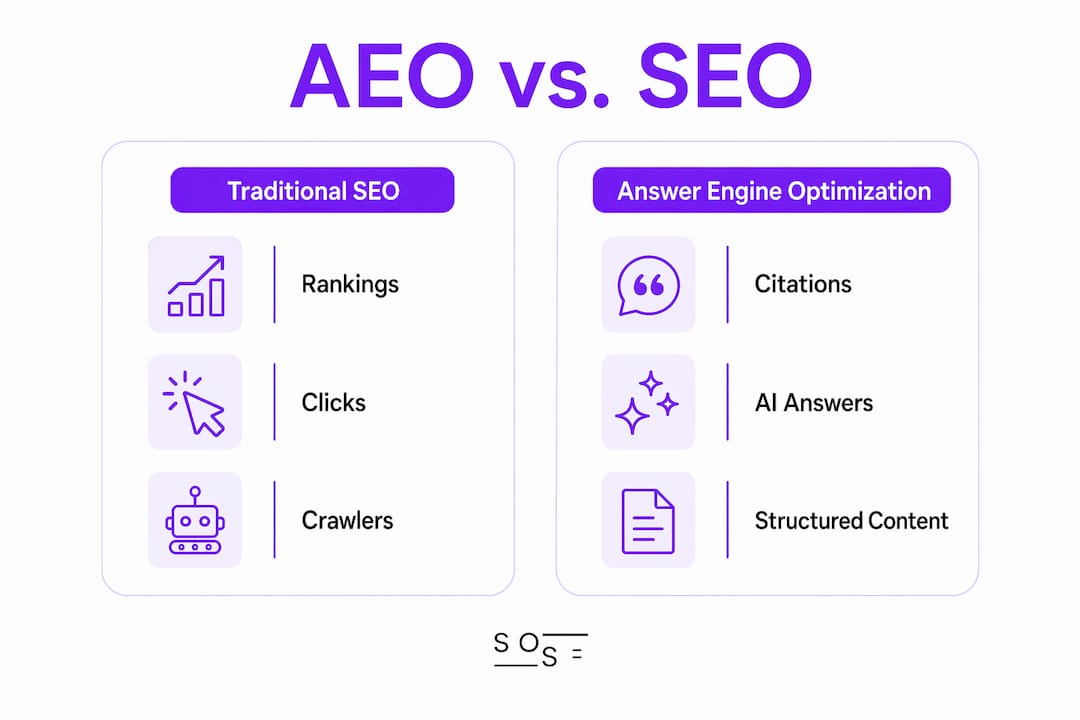
The two disciplines share a foundation but diverge sharply in execution. Here is the direct comparison:
| Dimension | Traditional SEO | Answer Engine Optimization |
|---|---|---|
| Primary goal | Rankings and organic clicks | AI citations and brand mentions |
| Optimized for | Human searchers on results pages | AI retrieval systems (LLMs, RAG) |
| Content unit | Full page or article | Self-contained chunk (H2/H3 + text) |
| Key signals | Backlinks, keyword density, page authority | Clarity, structure, trust signals, schema |
| Success metric | CTR, rank position, organic sessions | Citation frequency, share of voice, mention rate |
| Keyword strategy | Exact-match and semantic keyword targeting | Search intent mapping, question-format headings |
| Technical focus | Core Web Vitals, crawlability, indexing | Schema markup, speakable tags, AI crawler access |
The differences go beyond tactics. They reflect a different theory of how discovery works.
In traditional SEO, you win by being the most relevant page for a query. In AEO, you win by being the most extractable answer. A page can rank #1 and still never appear in an AI-generated response if its content is buried in long paragraphs, lacks clear structure, or does not directly address the query in the first sentence of each section.
Key practical contrasts worth internalizing:
- Content chunking: AEO requires every subheading and its content to function as an independently citable mini-article. SEO does not.
- Measurement: You track citation frequency and AI share of voice, not just rank positions. These require different tools.
- Trust signals: Author credentials, publish dates, and third-party validation matter more to AI systems than to Google's traditional ranking algorithm.
- Keyword use: AEO favors natural language questions and declarative statements over keyword-optimized phrases.
For a deeper look at how these three disciplines interact, the SEO vs. GEO vs. AEO comparison on the SOSEI blog breaks down where each approach applies and how to run them together.
Practical strategies for optimizing content for AI answer engines
The core principle is simple: write answers, not articles. Every section of your content should open with a direct, declarative response to the question implied by its heading. AI systems extract the first clear statement they find. If your answer is buried in paragraph three, it will not be cited.
Content aligned with the 3Cs of search intent (content type, format, and angle) significantly improves the chances of being selected as an AI answer source. Mapping each content chunk to a specific stage of the user journey, whether that is a definition, a comparison, a how-to, or an objection response, gives AI systems the contextual signal they need to match your content to the right query.
Practical strategies that move the needle:
- Lead with the answer (BLUF). Open every section with a one-to-two sentence direct response. Expand below it.
- Use question-format headings. "What is X?" and "How does Y work?" match the natural language queries AI systems process.
- Keep chunks self-contained. Each H2 or H3 section should answer its question without requiring the reader to have read the previous section.
- Favor scannable formats. Bullet points, numbered lists, and tables are easier for AI systems to parse and extract than dense prose.
- Map to intent stages. Cover definition, comparison, use case, and objection content for each core topic. Aligning content with clear intent stages maximizes citation coverage across the buyer journey.
- Use named entities and statistics. Answer engines prioritize clarity, trustworthiness, and structured relevancy. Specific facts, named tools, and cited figures signal authority.
- Close content gaps. Run your existing content against the questions your audience actually asks. If a query has no clear answer on your site, you cannot be cited for it.
For additional techniques on optimizing content for AI search, the frameworks around intent mapping and content modularization are worth reviewing alongside your own content audit.
Pro Tip: Treat your content management system as a chunk library, not a page library. Tag each section by intent type (definition, comparison, how-to, FAQ) and audit quarterly to confirm every chunk opens with a direct answer. This structural discipline is what separates brands that get cited from brands that get ignored.
Content structure and trust signals that AI engines actually rely on
Structure is not just about readability. It is the technical layer that tells AI systems what your content is, who wrote it, and whether it is reliable enough to cite.

Schema markup is the most direct signal you can send. Implementing FAQPage, HowTo, and Article schema via JSON-LD gives AI systems machine-readable metadata about your content's purpose and structure. The speakable property in Article schema specifically flags content as suitable for voice and AI extraction. These are not optional extras for AEO. They are table stakes.
| Trust signal | What it tells AI systems | Practical implementation |
|---|---|---|
| FAQPage schema | Identifies Q&A pairs for direct extraction | JSON-LD on FAQ sections |
| Author credentials | Signals expertise and accountability | Byline with bio, LinkedIn link |
| Publish and update dates | Indicates freshness and maintenance | Visible timestamps on all content |
| Backlinks and mentions | Third-party validation of authority | PR, co-branding, guest content |
| Speakable markup | Flags content for voice/AI reading | Article schema with speakable property |
| Page speed and crawlability | Confirms AI crawlers can access content | Clean HTML, fast load, no crawler blocks |
Frequently updating content with clear authorship and timestamps increases AI trust and citation likelihood. A page that was last updated three years ago with no author attribution sends a weak signal, regardless of how well-written it is.
Beyond schema, the basics matter more than most brands realize. Semantic HTML, logical heading hierarchy (H1 → H2 → H3), and a site architecture that AI crawlers can navigate without hitting JavaScript walls all contribute to whether your content gets indexed and extracted. Automating AI-specific files like llms.txt and AI sitemaps within your deployment pipeline gives platforms beyond Google a structured entry point to your content.
Third-party validation rounds out the trust picture. Backlinks from authoritative domains, brand mentions in industry publications, and co-branding with recognized organizations all signal to AI systems that your content is worth citing. This is not different from traditional SEO link building in principle, but the mechanism is different: AI systems weight co-occurrence and mention patterns, not just raw link counts.
How to measure AEO success with the right KPIs
Traditional analytics dashboards were not built for AEO. Organic sessions and rank positions tell you almost nothing about how often your brand appears in AI-generated answers. You need a different measurement layer.
Primary AEO KPIs to track:
- AI citation frequency: How often your brand or content is referenced in AI-generated answers across ChatGPT, Google AI Overviews, and other platforms.
- Brand mention rate: The share of relevant AI responses that include your brand name, even without a direct link.
- Share of voice in AI answers: Your brand's presence relative to competitors across a defined set of queries.
- Zero-click trend analysis: Monitoring whether branded queries are being resolved in AI answers without driving site visits.
- Fan-out coverage: The breadth of query types and intent stages for which your content is being cited.
Tools purpose-built for AI visibility tracking are emerging quickly. Platforms like Profound are designed specifically to monitor brand presence in AI-generated answers, filling the gap that Google Search Console and traditional rank trackers leave open. Regular audits and content refinement are essential because AI search models update frequently and citation patterns shift.
Integrating AEO metrics into your broader marketing analytics framework is the practical next step. Treat AI citation data the same way you treat branded search volume: as a leading indicator of brand awareness and consideration. When citation frequency rises, brand recall and direct traffic typically follow.
Challenges you will face as AEO matures
AEO is not a set-and-forget discipline. The platforms it targets are evolving faster than any previous search technology, and that creates real operational challenges for marketing teams.
Model updates and shifting extraction logic. AI systems update their retrieval and ranking logic without public changelogs. A content structure that earns citations today may underperform after a model update. This is the AEO equivalent of a Google core update, except it can happen more frequently and with less transparency.
Divergent platform requirements. Google explicitly advises against special AI training files like llms.txt for its own search products, recommending foundational SEO instead. Other AI platforms actively use these files. Running a dual-layer strategy, solid traditional SEO for Google plus structured AEO signals for other AI engines, is the practical answer, but it adds complexity to content governance.
Additional challenges worth planning for:
- Over-optimization risk. Content written purely for AI extraction can feel robotic to human readers. The best AEO content serves both audiences.
- Misinformation and accuracy. AI systems can misattribute or misquote content. Keeping your factual claims precise and clearly sourced reduces the risk of your content being cited inaccurately.
- Content pipeline governance. Implementing chunk-level tagging, schema automation, and AI crawler access across a large content library requires process changes, not just technical fixes.
- Ethical and transparency considerations. As AI training data practices evolve, brands need to monitor how their content is being used and whether opt-out mechanisms apply to their situation.
- Measurement immaturity. The tooling for tracking AI citations is still developing. Expect gaps in coverage and attribution, especially for platforms that do not expose citation data via API.
For a current read on how algorithm changes are affecting AI-driven visibility, the June 2026 search landscape update covers the May core update and its implications for AI Mode.
How SOSEI prepares your brand for AI search visibility
Most websites were not built with AEO in mind. They were built for human readers and traditional search crawlers, which means their content structure, schema implementation, and AI crawler access are typically inadequate for the current environment. That is the gap SOSEI addresses directly.
Sosei's AI-powered website rebuilds are designed from the ground up for visibility across both Google and AI answer engines. The process starts with a free 40-point audit that identifies exactly where your current site is losing ground, whether that is missing schema markup, poor mobile performance, unclear content structure, or blocked AI crawlers.
What a SOSEI rebuild delivers for AEO specifically:
- Industry-tailored content architecture across 160+ industries, with heading structures and chunk formats optimized for AI extraction.
- Integrated schema markup (FAQPage, HowTo, Article, Organization) deployed automatically across the rebuilt site.
- AI crawler compatibility with proper
robots.txtdirectives and AI-readable content formats. - Real-time content updates so your site stays fresh, which is a direct trust signal for AI citation systems.
- Analytics integration that supports tracking both traditional SEO and emerging AEO metrics from day one.
- WCAG 2.1 AA accessibility and a GDPR-ready privacy baseline built in, which also supports the semantic HTML structure AI systems prefer.
- Voice assistant readiness with speakable markup and conversational content formats.
Pro Tip: When planning your SOSEI rebuild, bring your content team into the process early. The rebuild is the technical foundation, but the citation gains compound when your editorial workflow adopts chunk-first writing from the start. Map your top 20 queries before the rebuild launches and confirm each one has a dedicated, self-contained answer section in the new architecture.
Sosei's approach treats AEO not as a feature to bolt on, but as a structural requirement baked into every rebuild. For brands that have been watching AI search eat into their organic visibility, the rebuild is the fastest path to a site that is genuinely ready for the current environment. You can review the full feature set to see how each element maps to AEO requirements.
What real AEO success looks like in practice
The most instructive examples of AEO working come from brands that treated content structure as a strategic asset, not a publishing afterthought.
HubSpot's own AEO strategy is one of the most cited cases in the industry. By restructuring their knowledge base and blog content around self-contained, question-led sections with clear schema markup, they saw significant improvements in qualified lead generation, with some early adopters reporting over 1800% increase in qualified leads. The mechanism was not a traffic surge. It was AI systems consistently citing HubSpot content in answers to marketing and CRM questions, placing the brand in front of buyers at the research stage.
The pattern holds across categories. Brands that have invested in FAQ optimization strategies, structured their product and service pages around specific user queries, and implemented FAQPage schema consistently show up in Google AI Overviews for their core topics. The brands that do not appear in those overviews typically have the same underlying issue: content written for keyword density rather than direct answers.
A few characteristics shared by brands seeing strong AEO results:
- They treat every major query their audience asks as a content gap to fill with a dedicated, self-contained answer.
- They publish with clear authorship, visible update dates, and linked credentials.
- They use schema markup not just on FAQ pages but across product pages, how-to guides, and comparison content.
- They monitor AI citation frequency as a primary KPI, not an afterthought.
The shift from chasing clicks to earning citations is not theoretical for these brands. It is reflected in their content calendars, their measurement dashboards, and their website architecture. That alignment between strategy and execution is what separates brands that appear in AI answers from those that do not. For a broader view of how AI-driven search is reshaping visibility strategies, the patterns emerging across industries point in the same direction.
Key Takeaways
Answer engine optimization requires structuring content as self-contained, AI-extractable chunks backed by schema markup, clear authorship, and search intent mapping to earn citations in AI-generated answers.
| Point | Details |
|---|---|
| AEO targets citations, not clicks | AI-referred traffic builds brand awareness and consideration before a buyer ever visits your site. |
| Content chunking is non-negotiable | Every H2/H3 section must answer its query independently, without relying on surrounding context. |
| Schema markup is table stakes | FAQPage, HowTo, and Article schema give AI systems the structured signals needed to extract and cite your content. |
| Measure AI share of voice | Track citation frequency and brand mention rate alongside traditional SEO metrics to get the full visibility picture. |
| SOSEI rebuilds sites for AEO from the ground up | SOSEI's AI-powered rebuilds include integrated schema, AI crawler compatibility, and chunk-optimized architecture across 160+ industries. |
Your website may already be invisible to AI search
If your site was built before 2024, there is a real chance it is missing the structural signals AI answer engines look for. No schema markup, no AI crawler directives, no chunk-optimized content structure. That is not a minor gap. It means your brand is absent from a growing share of the answers your potential customers are reading right now.
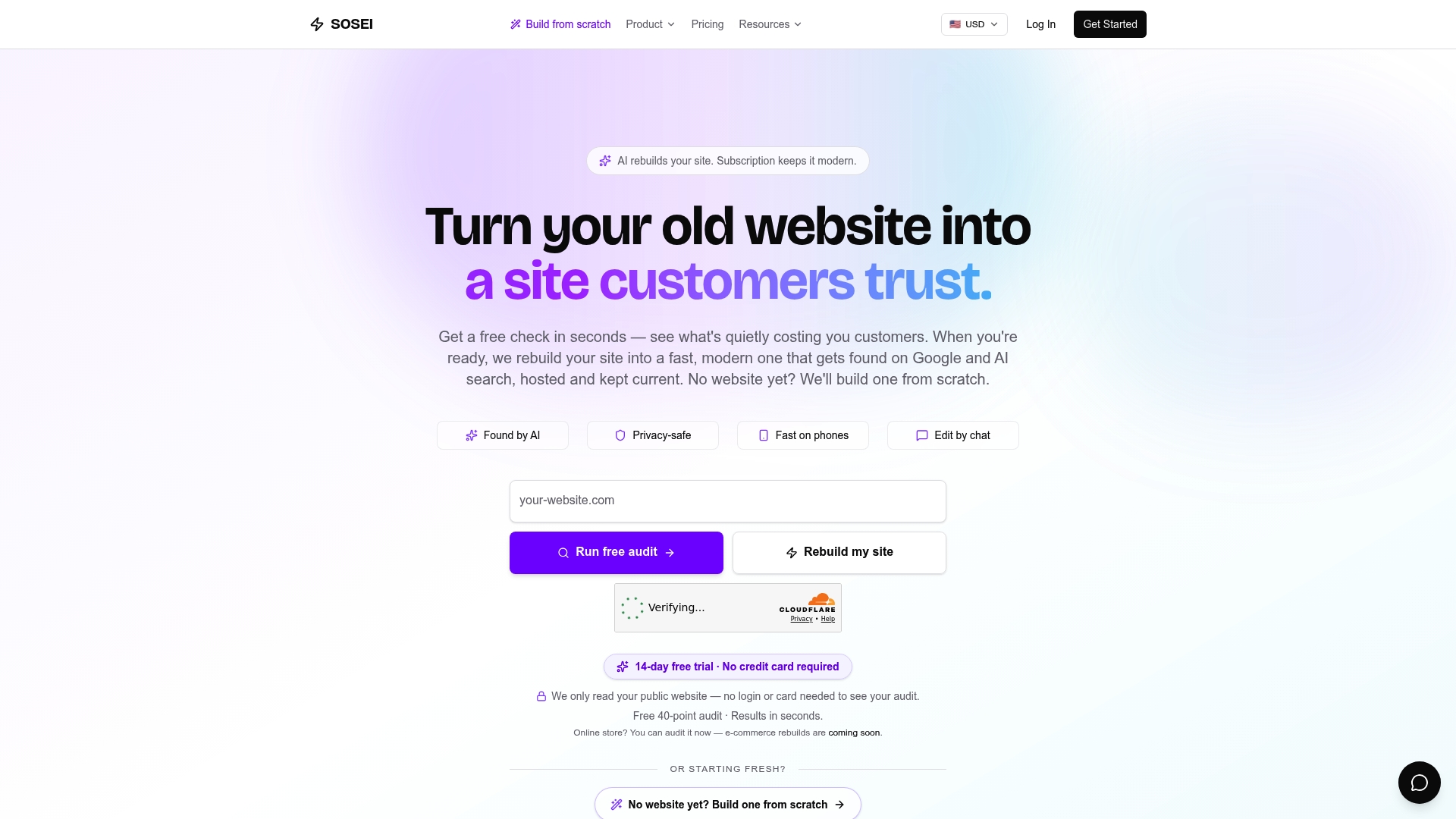
Sosei rebuilds websites specifically for this environment. Every rebuild includes integrated schema markup, AI-readable content architecture, voice assistant readiness, and real-time update capability, all configured for your industry from day one. There is no agency retainer, no multi-year contract, and no starting from a generic template. The free 40-point audit shows you exactly where your current site is losing ground in AI search before you commit to anything. Start there.