AI Visibility Audit: A 2026 Small-Business Guide
Discover how an AI visibility audit can enhance your small business's online presence. Ensure your site is found by AI searches in 2026.
An AI visibility audit is a structured process that tests whether AI search engines can find, read, and recommend your website, revealing specific gaps that block your brand from appearing in AI-driven answers. This is not the same as a traditional SEO audit. Where SEO audits measure keyword rankings and backlinks, an AI search audit measures whether platforms like ChatGPT, Perplexity, Gemini, and Claude actually cite your brand when customers ask questions. For small business owners and marketers, this distinction matters more than ever. The buyer journey in 2026 runs through conversational AI, and if your site is invisible there, you are losing customers you never knew you had.
What is an AI visibility audit and why does it matter?
An AI visibility audit is a systematic check across three layers: can AI crawlers access your site, can they understand your content, and do they recommend your brand in answers? Each layer is a gate. Failing the first one means the other two are irrelevant.
AI visibility audits differ fundamentally from SEO or PR reports because they measure brand presence in generative AI answers, not link rankings. A site can rank on page one of Google and still be completely invisible to ChatGPT or Perplexity. That gap is exactly what this audit type is designed to expose.

The stakes are real. AI-driven buyer journeys now demand visibility in generative answers to secure organic traffic. If a potential customer asks Gemini "what's the best accounting software for a small bakery" and your brand never appears, no amount of Google ranking will recover that lost opportunity.
What are the core layers of an AI visibility audit?
The audit runs in three sequential layers. Each one builds on the last, so you must work through them in order.
Layer 1: Crawlability
Crawlability asks a simple question: can AI bots physically reach your pages? GPTBot, ClaudeBot, and PerplexityBot all need clean access. Common blockers include misconfigured robots.txt files, aggressive firewalls, and CDN rules that treat AI crawlers like malicious traffic. The numbers here are sobering. Only 30% of audited brands passed the crawlability layer cleanly in april 2026. That means 70% of sites had a foundational access problem before content quality even entered the picture. Check the SOSEI guide on AI crawlers in 2026 for the full allowlist of bots your site should be welcoming.
Layer 2: Extractability
Once a crawler reaches your page, it needs to extract a clear, usable answer. SEO page structures with lengthy introductory text before core answers are often invisible or poorly extractable by AI systems. AI prefers direct answers near the top of the page, written in plain language. JavaScript-rendered content, missing schema markup, and buried answers all cause extractability failures. A page that looks great to a human reader can be nearly unreadable to an AI parser.
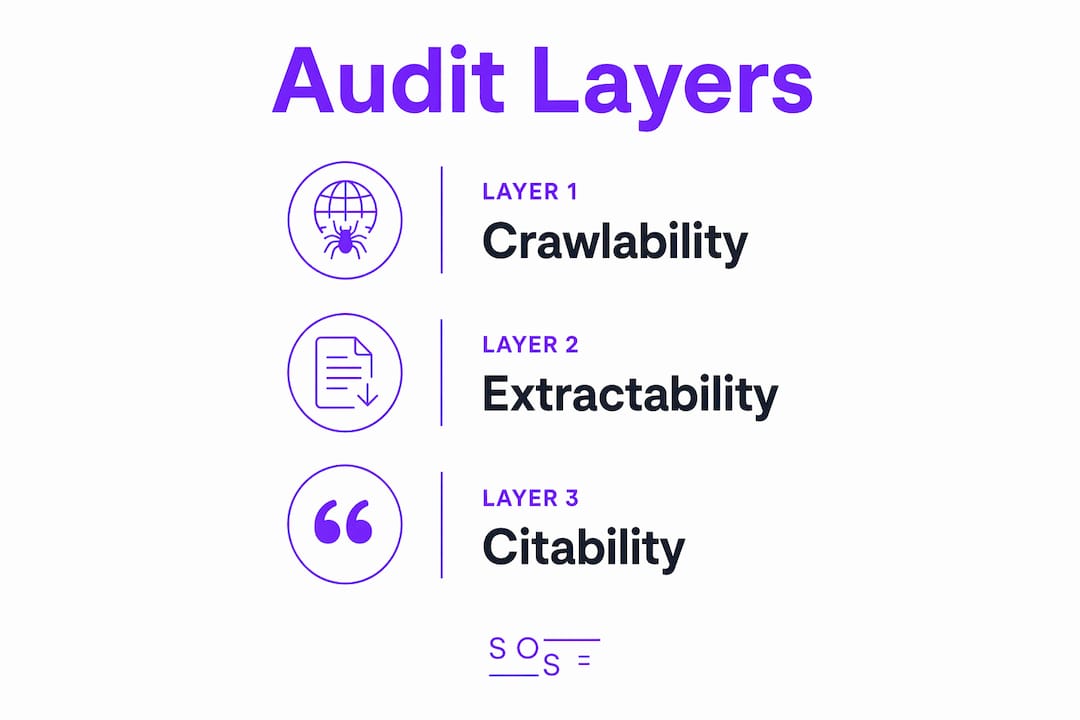
Layer 3: Citability
Citability is the hardest layer to control. It asks whether AI platforms actually recommend your brand in their answers. This depends on brand entity recognition, the strength of your off-site presence, and how consistently your brand name appears across the web. A weak entity footprint means AI systems do not have enough signal to trust your brand as a source.
Pro Tip: Fix crawlability before touching schema or content. Technical crawlability fixes must precede content optimizations because a blocked crawler never sees your best content.
How do you conduct an AI visibility audit step by step?
A practical audit does not require an agency. You can run a solid assessment in 45 minutes to 4 hours, depending on how deep you go. Quarterly frequency is the recommended cadence to track changes and catch regressions.
- Build a prompt set. Write 10–15 questions your real customers ask. Use buyer-intent phrasing like "what's the best [your category] for [specific need]" rather than generic keyword phrases. These prompts simulate how AI platforms receive customer queries.
- Run prompts across platforms. Test each prompt in ChatGPT, Perplexity, Gemini, and Claude. Use incognito mode to avoid personalization bias. Run each prompt at least three times to capture answer variability. A single run can mislead you because AI answers shift between sessions.
- Log your results. For each prompt and platform, record whether your brand was mentioned, cited with a link, or absent. Note which competitors appeared. This log becomes your baseline scorecard.
- Run technical checks. Fetch your key pages using a bot-simulation tool. Review your robots.txt file for any rules that block GPTBot or similar crawlers. Validate your schema markup using Google's Rich Results Test. Check whether your core pages render without JavaScript dependency.
- Score across five categories. A self-assessment worksheet covering entity footprint, off-site presence, extractability, structured signals, and technical access takes about 20 minutes to complete. Score each area and identify your lowest-performing category first.
Pro Tip: Do not skip the multi-platform step. ChatGPT cites Reddit and Wikipedia, Perplexity pulls from real-time web sources, and Claude leans on official documentation. Your brand may appear on one platform and be invisible on another.
What are the most common AI visibility gaps?
Most small business sites fail in predictable patterns. Knowing these patterns lets you prioritize fixes without wasting time on low-impact changes.
- Inconsistent brand naming. If your business appears as "Smith Plumbing," "Smith Plumbing LLC," and "Smith & Sons Plumbing" across the web, AI systems struggle to build a coherent entity. Pick one canonical name and use it everywhere.
- Weak off-site presence. AI platforms source information from trusted third-party domains. Missing presence on Reddit, Wikipedia, or news sites causes invisibility on specific AI engines. A brand with no mentions outside its own website has almost no citation potential.
- Buried answers. Long introductory paragraphs before the actual answer are an extractability killer. If your FAQ page takes three paragraphs to get to the answer, AI systems often skip it entirely.
- JavaScript-dependent content. Content that only loads after JavaScript executes is frequently invisible to AI crawlers. Core answers should exist in the raw HTML of the page.
- Robots.txt misconfigurations. A single overly broad disallow rule can block every AI crawler on your site. This is the most common and most fixable crawlability failure.
- Missing or invalid schema. Schema markup in formats like FAQ, HowTo, and Article gives AI systems explicit signals about your content structure. Missing schema forces AI to guess, and it often guesses wrong.
Pro Tip: Prioritize in this order: fix technical access first, then improve off-site presence, then refine extractability. Skipping ahead to content polish while crawlers are still blocked is the audit equivalent of painting a house with a broken foundation.
The timeline for fixes varies by type. Technical changes like robots.txt corrections take effect within days. Off-site presence improvements through PR, directory listings, and community participation take weeks to months before AI platforms register the change. Plan accordingly and set realistic expectations with your team.
How does an AI visibility audit connect to your broader marketing strategy?
An AI visibility audit does not replace your SEO strategy. It extends it. Traditional SEO audits focus on indexability and keyword rankings, while AI visibility audits test whether specialized AI crawlers can reach, parse, and cite your brand within generative answers. Both matter, and the findings from each inform the other.
The practical integration looks like this. Audit findings on extractability feed directly into your content strategy. If AI systems cannot extract clear answers from your service pages, those pages need restructuring regardless of their Google ranking. Audit findings on off-site presence feed into your PR and link-building calendar. Gaps in schema markup feed into your technical development backlog.
Tracking improvement requires repeated audits. Run your prompt set quarterly and compare mention rates, citation rates, and platform coverage against your baseline. A 5-tier citation scoring system evaluates brand presence from invisible to top recommendation, giving you a nuanced picture of progress beyond a simple mentioned/not-mentioned binary.
The 2026 buyer journey touches ChatGPT, Google AI Overviews, and Gemini before it ever reaches a company website. Brands that appear consistently in those answers build trust before the first click. For small businesses competing against larger players, that early-stage presence is a real advantage. The SOSEI guide on SEO vs GEO vs AEO breaks down how these three visibility channels interact and where to focus first.
Quarterly audits also help you adapt as AI platforms evolve their sourcing behavior. What Perplexity cited six months ago may not be what it cites today. An ongoing quarterly audit cadence keeps your strategy current rather than reactive.
Key Takeaways
An AI visibility audit is the most direct way to identify why your brand is missing from AI-driven search answers, and fixing crawlability first delivers the fastest, highest-impact results.
| Point | Details |
|---|---|
| Audit layers are sequential | Fix crawlability before extractability or citability, or your content work is wasted. |
| 70% of brands fail crawlability | Most sites block AI crawlers unintentionally through robots.txt or firewall rules. |
| Run prompts three times minimum | Single-run audits mislead because AI answers vary between sessions. |
| Off-site presence drives citability | Presence on Reddit, Wikipedia, and news domains determines which AI platforms cite you. |
| Quarterly audits are required | AI platform sourcing behavior changes, so a one-time audit becomes outdated fast. |
Why most small businesses are auditing the wrong thing
I have reviewed a lot of website audits for small business owners, and the pattern is almost always the same. The audit is a Google Search Console export with some keyword rankings attached. The business owner looks at it, sees green checkmarks, and assumes their digital presence is healthy. Then they wonder why their phone is not ringing.
The uncomfortable truth is that ranking well on Google and being visible to AI are two completely separate outcomes. A site can pass every traditional SEO check and still be invisible to ChatGPT, Perplexity, and Gemini. I have seen this firsthand with businesses in competitive local markets. Their Google presence was solid. Their AI presence was zero.
What changed my thinking on this was watching how buyers actually behave now. They ask ChatGPT "who's the best roofer near me" or "what should I look for in a bookkeeper." They get a confident, specific answer. They call that business. The brands that appear in those answers did not get there by accident. They ran an audit, found the gaps, and fixed them.
The other misconception I see constantly is treating an AI visibility audit as a one-time project. It is not. AI platforms update their sourcing behavior, add new citation signals, and change how they weight off-site presence. The businesses that stay visible are the ones that audit quarterly and treat it as a normal part of their marketing rhythm, not a crisis response.
My honest advice: start with the crawlability check. It takes 20 minutes and it is the single highest-leverage fix available. If AI crawlers cannot reach your pages, nothing else matters.
— Meiko
How SOSEI addresses the gaps your audit uncovers
Running an AI visibility audit tells you exactly what is broken. Acting on those findings is where most small businesses stall.
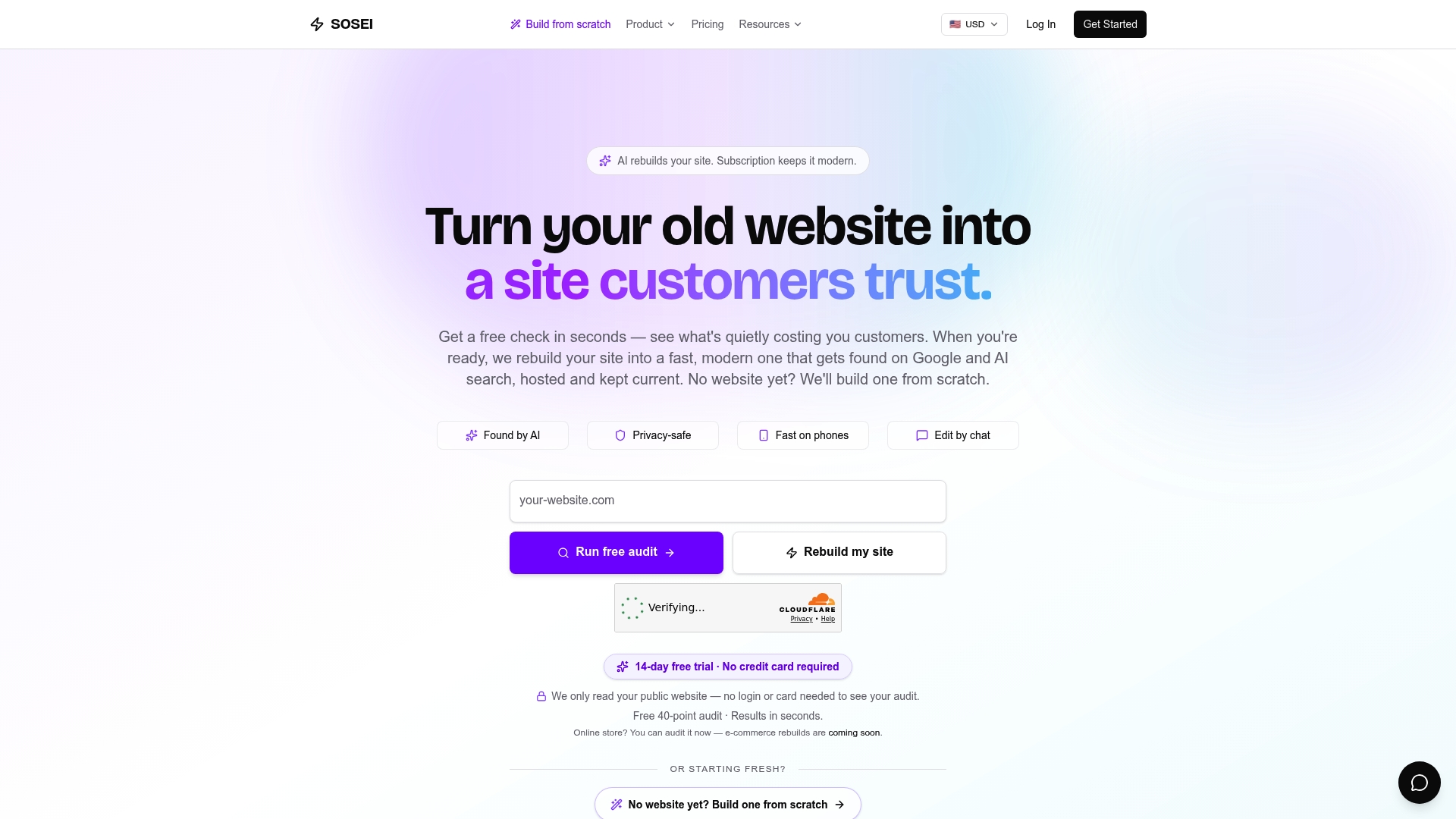
Sosei rebuilds websites from the ground up with AI crawler access, structured data, and clean content extraction built into every page. The free 40-point audit SOSEI runs before any rebuild covers the same technical and content layers that an AI visibility audit surfaces, so you are not starting from scratch. Every rebuild is customized across more than 160 industries, which means your site is structured for the specific questions your customers actually ask AI platforms. If your audit revealed crawlability blocks, schema gaps, or buried answers, a SOSEI website rebuild addresses all three as part of a single, coordinated process rather than a patchwork of separate fixes.
FAQ
What is an AI visibility audit?
An AI visibility audit is a structured check that tests whether AI search platforms like ChatGPT, Perplexity, and Gemini can access, understand, and cite your brand in their answers. It differs from a traditional SEO audit by measuring generative AI presence rather than keyword rankings.
How long does an AI visibility audit take?
A focused audit takes 45–60 minutes, while a thorough audit runs 3–4 hours. Quarterly audits are recommended to track changes and adapt to evolving AI platform behavior.
Why does my site rank on Google but not appear in AI answers?
A site can pass every SEO check and still block AI crawlers through robots.txt rules or firewall settings. Passing a Google audit does not equal AI visibility because the two systems use different crawlers and different citation signals.
Which AI platforms should I test during an audit?
Test ChatGPT, Perplexity, Gemini, and Claude at minimum. Each platform sources content differently, so your brand may appear on one and be absent from another.
How do I improve my AI citation rate after an audit?
Fix technical access first, then build off-site presence on domains like Reddit, Wikipedia, and industry news sites, then restructure page content so direct answers appear near the top in plain language.