AI Search Optimization: The Multi-Surface Guide
Unlock the secrets of AI search optimization in 2026. Learn how to structure content and boost visibility across AI platforms effectively.
AI search optimization is the practice of structuring content and technical SEO so that AI-driven search platforms cite your website in generated answers. It builds on traditional SEO but adds new layers: answer capsules, semantic HTML, FAQPage schema, and engine-specific sequencing. Ranking first in Google no longer guarantees visibility. Citation rates vary from 17% to 54% even for the top-ranked result in AI Overviews. That gap is the problem this guide solves. You will learn which foundational signals still matter, how to structure content for citation, and how to sequence your efforts across the five major AI surfaces in 2026.
What foundational SEO principles still matter for AI search optimization?
AI search optimization is an evolution of traditional SEO, not a replacement for it. Google's May 2026 guidance confirms that core ranking systems handle AI-driven search without requiring content chunking, AI-specific rewrites, or special schema versions. That means the fundamentals you already know are still your baseline.
Technical accessibility
AI bots crawl your site the same way traditional search bots do. Technical factors like crawlability, mobile usability, and page speed all affect whether AI engines can read and retrieve your content. If your site blocks crawlers or loads slowly on mobile, no amount of structural content work will fix your AI visibility. SOSEI's AI crawler allowlist guide identifies the 18 bots your site should welcome in 2026.
Content quality and trust signals
AI engines favor non-commodity content: material that is expert, specific, and verifiable. Entity recognition matters here. When your brand appears consistently across authoritative third-party sources, AI engines treat you as a trustworthy entity worth citing. Reviews, consistent NAP data, and earned media all feed this trust layer.
Here are the foundational requirements you need to have in place before adding any AI-specific overlays:
- Crawlability: Confirm AI bots are not blocked in your robots.txt file.
- Mobile usability: Pass Google's mobile-friendly test with no critical errors.
- Page speed: Achieve a Core Web Vitals score of "Good" on both mobile and desktop.
- Content quality: Publish expert, specific content that cannot be found verbatim elsewhere.
- Trust signals: Maintain consistent citations, reviews, and entity mentions across the web.
Pro Tip: Skip content chunking and AI-specific keyword rewrites entirely. Google's own 2026 guidelines confirm these tactics add no value and can fragment your content quality.
How to structure your content for maximum AI citation
Content structure is the single biggest lever you control for AI citation. The goal is to make it easy for AI engines to lift your content verbatim into a generated answer.
Answer capsules
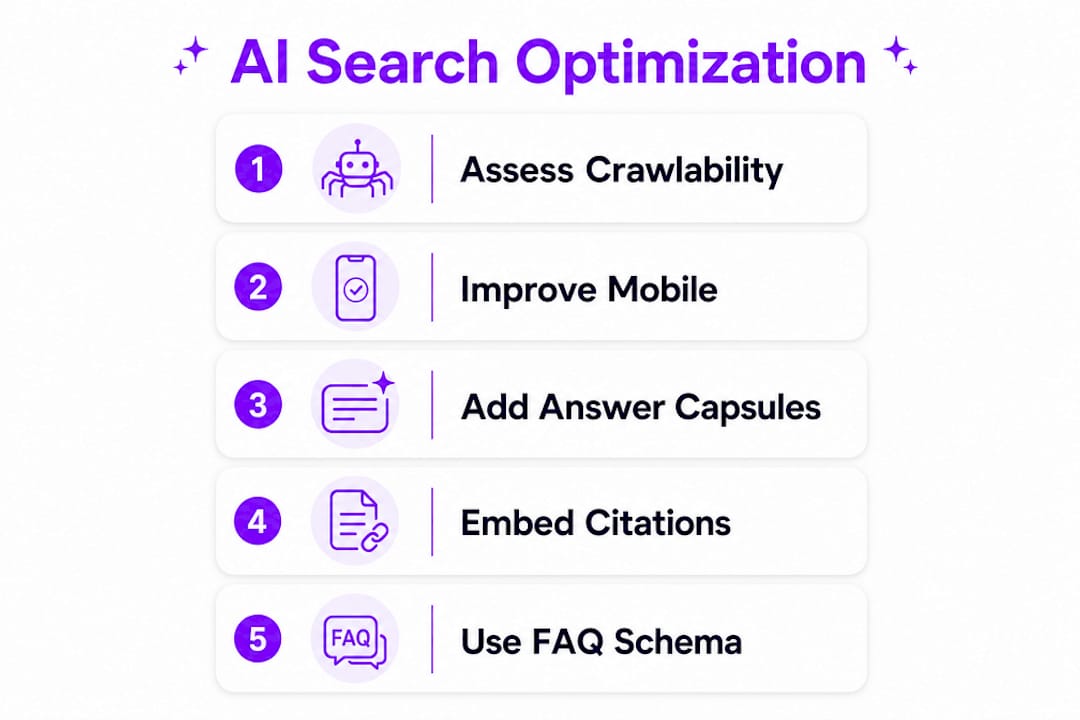
Place a 40–60 word definitional summary directly beneath every H1 and H2 heading. These "answer capsules" have the highest probability of being quoted verbatim in AI summaries. Write them as standalone definitions, not as teasers for the section below. A reader who sees only that paragraph should walk away with a complete answer.
Semantic HTML tables
Use semantic HTML tables for any comparison or list data. Semantic HTML tables improve AI retrieval fidelity compared to markdown or plain text tables. AI engines parse the structured data more reliably, which means your comparison content is more likely to appear in generated responses.
| Content element | AI citation impact |
|---|---|
| Answer capsule (40–60 words) | Highest verbatim lift probability |
| Semantic HTML table | Improved retrieval fidelity for comparisons |
| Inline statistics | +32% citation likelihood |
| Inline citations | +30% citation likelihood |
| Quotations from experts | +41% citation likelihood |
Statistics, citations, and FAQ schema
Adding hard statistics increases citation likelihood by 32%, and inline citations add another 30%. Quotations push that figure up by 41%. These are not decorative elements. They are structural signals that tell AI engines your content is verifiable and worth referencing. Pair every FAQ section with FAQPage schema to align with AI Q&A extraction patterns.
Pro Tip: Write every answer capsule as if it will be read in isolation. If it only makes sense in context of the surrounding paragraphs, rewrite it until it stands alone.
What are the key AI search engines and how should you sequence your efforts?
89% of AI citations are engine-specific. Only 11% of domains get cited by more than one AI engine. That means a volume-first approach, where you try to optimize for everything at once, wastes resources and makes results impossible to measure. A phased sequence works better.
The five major AI surfaces in 2026 are Microsoft Copilot, Google AI Overviews, ChatGPT, Perplexity, and an emerging tier that includes Grok, Claude, and DeepSeek. Each has distinct source preferences and retrieval patterns.
- Microsoft Copilot (start here): Microsoft Copilot offers free measurement through Bing Webmaster Tools' AI Performance report, a commercial-heavy query mix, and a thinner retrieval index. Thinner index means less competition for citation. This is your best first investment.
- Google AI Overviews (second): Layer in FAQ schema and video content here. Posts with 7 or more images earn 116% more organic traffic, and AI Overviews now support multimodal content. Measure progress through Google Search Console's AI filter.
- ChatGPT (third): ChatGPT relies heavily on entity recognition. Build or strengthen your Wikipedia presence and ensure your brand appears in authoritative third-party sources before targeting this surface.
- Perplexity (fourth): Reddit dominates Perplexity citations. Authentic participation in niche subreddits matters more here than any on-site change.
- Emerging tier (last): Grok, Claude, and DeepSeek are growing but lack first-party measurement tools. Optimize for them after you have established measurable wins on the first four surfaces.
Pro Tip: Use Bing Webmaster Tools' AI Performance report and Google Search Console's AI Overviews filter as your primary measurement instruments. Both are free and give you engine-specific citation data.
How do third-party citations and community presence boost AI visibility?
External signals drive AI citation more than most marketers expect. Third-party citations increase AI citation rates up to 75 times compared to content with no external references. Earned media accounts for 84% of all AI citations. That is not a marginal factor. It is the dominant one.
"Earned media and third-party citations account for 84% of all AI citations. On-page optimization alone cannot replicate that trust signal. The brands winning in AI search are the ones that have built genuine external authority over time."
Here is where to focus your external signal building:
- Reddit: Perplexity draws nearly half of its citations from Reddit. Participate authentically in subreddits relevant to your industry. Answer questions with depth, not promotional copy.
- YouTube: Google AI Overviews cite YouTube heavily. Publish video content that mirrors your written content pillars. A blog post and a corresponding video on the same topic doubles your citation surface.
- Earned media: Pitch data-driven stories to industry publications. A single citation in a high-authority outlet can multiply your AI citation rate across multiple engines.
- Citation consistency: Clean up inconsistent NAP data and brand mentions across directories and review platforms. Inconsistency signals low trustworthiness to AI retrieval systems.
The multi-surface search approach that works in 2026 combines on-page structure with genuine off-page authority. Neither works well without the other.
Pro Tip: Superficial Reddit or YouTube presence backfires. AI engines and human moderators both detect low-effort participation. Commit to genuine, long-term community engagement or skip the channel entirely.
Key takeaways
AI search optimization requires a shared discipline of structured content and earned authority before any engine-specific overlay will produce consistent, measurable citation results.
| Point | Details |
|---|---|
| Foundational SEO still applies | Crawlability, mobile usability, and content quality remain prerequisites for AI visibility. |
| Answer capsules drive citation | Place 40–60 word definitional summaries beneath every major heading for highest verbatim lift. |
| Sequence your engine targets | Start with Microsoft Copilot for free measurement, then layer Google AI Overviews, ChatGPT, and Perplexity. |
| Earned media dominates | Third-party citations account for 84% of AI citations; on-page work alone cannot match that signal. |
| Engine overlap is minimal | Only 11% of domains earn citations from multiple AI engines, so focus beats volume every time. |
Why I think most marketers are approaching AI search backwards
The instinct I see most often is to chase the newest AI engine first. Someone reads that ChatGPT is growing and immediately starts building Wikipedia pages and pitching tech journalists. Meanwhile, their site blocks half the AI crawlers, their mobile speed score is failing, and they have no measurement framework in place. They are building the roof before the foundation.
The search landscape in 2026 rewards a different order of operations. Get your technical house in order. Build the shared discipline of answer capsules, semantic tables, and FAQ schema. Then start with Microsoft Copilot because you can actually measure what is working. That measurement data tells you whether your structural content is landing before you invest in engine-specific overlays.
The other mistake I see is treating AI search as a separate discipline from SEO. It is not. AI search and traditional SEO share the same quality signals. The structural additions are a layer on top, not a replacement. Marketers who abandon their SEO fundamentals to chase AI-specific tactics end up worse off on both fronts.
The brands that will win in AI search over the next two years are not the ones who moved fastest. They are the ones who built genuine authority, structured their content clearly, and measured their way to multi-surface visibility. That is a slower path, but it compounds.
— Meiko
How SOSEI builds AI-ready websites from the ground up
Getting your site ready for AI search visibility means fixing technical gaps, restructuring content, and implementing schema. That is a lot to coordinate, especially if your current site was built before AI search existed.
Sosei's AI website rebuilder handles the full stack: crawlability for AI bots, mobile-first architecture, FAQPage schema, semantic HTML structure, and answer capsule formatting across your key pages. The free 40-point audit identifies exactly which gaps are costing you citations right now. SOSEI covers over 160 industries, so the rebuild reflects your specific content needs rather than a generic template. If you want measurable AI search visibility without rebuilding your site piece by piece, see what SOSEI builds.
FAQ
What is AI search optimization?
AI search optimization is the practice of structuring content and technical SEO so AI-driven platforms cite your site in generated answers. It builds on traditional SEO with added elements like answer capsules, semantic HTML tables, and FAQPage schema.
Does traditional SEO still matter for AI search?
Yes. Google's 2026 guidelines confirm that core ranking systems handle AI-driven search. Technical accessibility, content quality, and trust signals remain the baseline requirements for AI citation.
Which AI search engine should I optimize for first?
Start with Microsoft Copilot. It offers free measurement through Bing Webmaster Tools, a commercial-heavy query mix, and a thinner retrieval index that makes citation easier to earn early.
How do I increase my chances of being cited by AI engines?
Use 40–60 word answer capsules beneath headings, add inline statistics and citations, implement FAQPage schema, and build earned media presence. Third-party citations account for 84% of all AI citations.
Do I need different content for each AI engine?
No. Build a shared discipline of structured, authoritative content first. Then add engine-specific overlays: FAQ and video for Google AI Overviews, entity presence for ChatGPT, and Reddit engagement for Perplexity.